


HOW TO CHOOSE A SILK PILLOWCASE

On the web, silk pillowcases can be found at prices ranging from 30 to 200 euros.
But are they all the same?
The differences are there, but they are often not visible.


Cheap Silk Pillowcases: what you need to know
Not all silk pillowcases are what they seem: here's what you need to know before choosing.

LONG-LASTING DURABILITY
They get ruined easily
Cheap silk pillowcases tend to deteriorate quickly with use and machine washing.
This behavior is mainly linked to the inferior quality of the raw material: less selected yarns are often used, making the fabric structurally weaker and less stable over time.
In addition, the dyeing processes, which involve the use of chemical agents, can accelerate the deterioration process over time.
Another determining factor is the absence of fabric finishing treatments. Processes such as stabilization, which are fundamental for stabilizing the fiber, reducing internal tensions, and improving dimensional resistance, are generally not applied to lower-end products. Without these steps, silk tends to deform, shrink, and lose compactness after just a few washing cycles.
The combination of these elements leads to a rapid decline in fabric performance: the surface frays, the structure loses uniformity, and the product is unable to maintain the typical characteristics of quality silk over time.

DYE
Chemical coloring
Inexpensive silk pillowcases are often dyed for purely aesthetic reasons.
The dyeing process, which involves the use of chemical agents, can compromise the intrinsic and natural characteristics of silk, consequently reducing its benefits for skin and hair.

ORIGIN AND PRODUCTION CHAIN
Made in China
Cheap silk pillowcases are predominantly imported products. They have easily identifiable recurring characteristics, such as packaging in magnetic-closure boxes and pastel colors.
The price difference compared to a Made in Italy product is attributable to less traceability and limited control along the production chain. At the same time, operating and working conditions can contribute to a significant reduction in costs.
Why choose our Silk Pillowcases?
Here are the reasons why we are the Silk Pillowcase Specialists.

Raw material selection
Our silk pillowcases are the result of a rigorous selection of raw materials because the value of the finished product depends directly on the characteristics of the thread from which it is made.
Silk originates from the cocoon, and a first selection is made at this stage: only the most uniform ones, free from imperfections, capable of guaranteeing continuity and purity of the filament, are used. This is a fundamental step because any original defects inevitably reflect on the fabric.
Subsequent stages, such as drying and reeling, also require controlled conditions and great precision. Silk is a protein fiber composed of fibroin and sericin, and its balance can be easily compromised: incorrect temperatures or inadequate processing can alter its structure, reducing the cohesion, uniformity, and stability of the thread.
Our silk pillowcases are made from continuous, regular, and strong filaments, obtained from raw materials processed in respect of the fiber's natural characteristics.

Silk finishing treatment
The quality of silk depends not only on the raw material but also on how it is processed. This is why each of our pillowcases undergoes a careful and controlled finishing process, designed to enhance the natural characteristics of the fiber without altering them.
Through treatments such as fabric stabilization, the silk maintains its compact structure, brilliance, and resistance to washing over time, preventing fraying or loss of quality.
The result is a silk pillowcase that retains its beauty night after night, always offering the same sensation of softness and comfort. Finishing is not an addition: it is what transforms good silk into a product designed to last.

Only natural white
Our silk is left in its original color: natural white, a symbol of purity and authenticity.
We avoid any chemical dyeing treatments because they alter the fiber's structure and reduce its beneficial properties.
The result is a pillowcase that retains the natural qualities of silk: gentle on the skin, breathable, naturally hypoallergenic, and respectful even of the most sensitive skin.
Its natural white is not just an aesthetic choice, but a declaration of quality.

Made in Italy
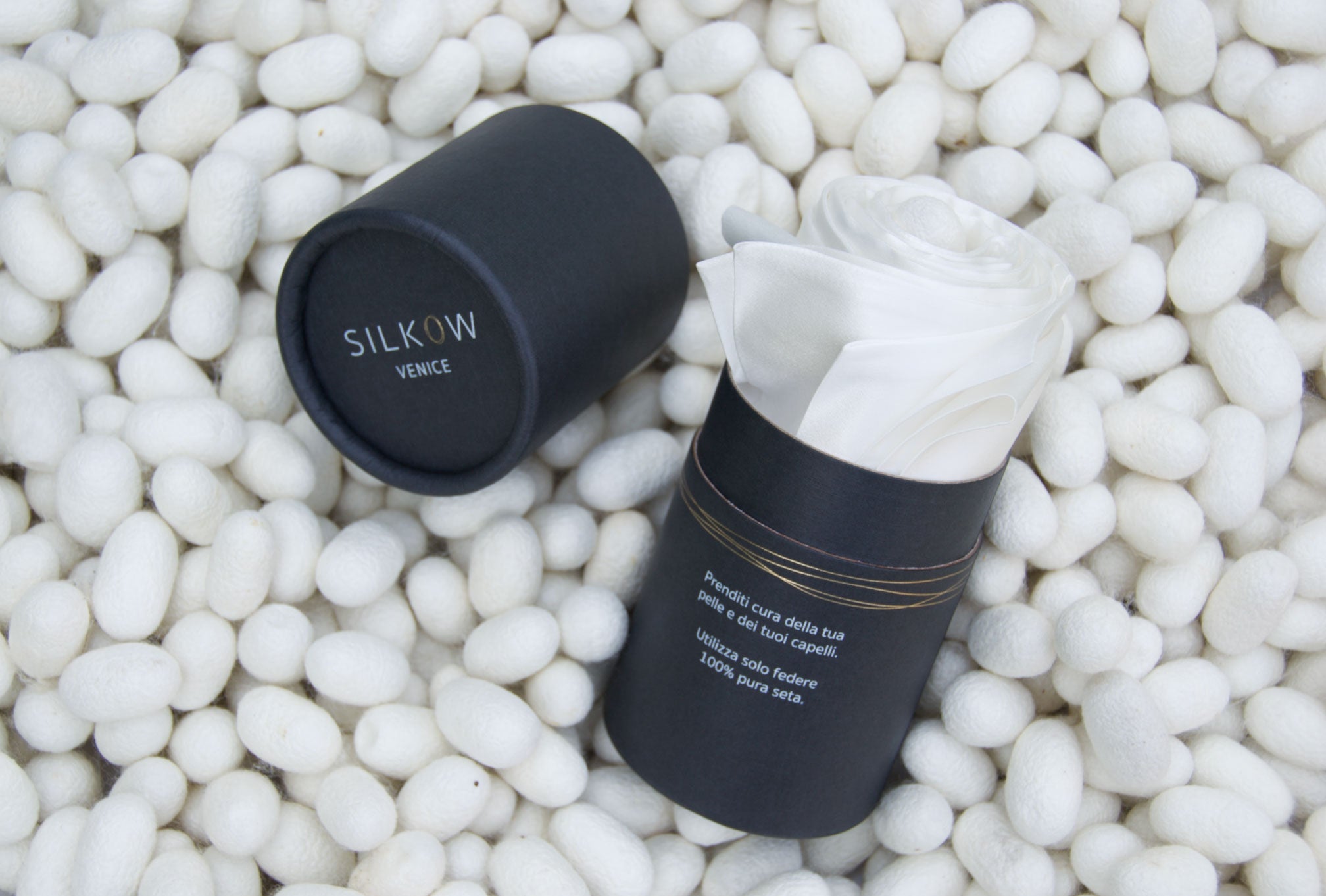
Every silk pillowcase of ours is born in Italy, a few kilometers from Venice, in artisanal workshops that preserve expertise and attention to detail.
For us, Made in Italy is not just a place of production, but a value: it means controlled quality, a short supply chain, respect for the territory and for the people who live there.
From manufacturing to packaging, every element is designed to reflect a precise idea of excellence: essential, authentic, and uncompromising.
Choosing a product made in Italy means choosing a history, a culture, and a care that can be perceived in every detail.
THE WORLD OF SILK: BETWEEN MARKETING AND REALITY
Not everything you read on other sites is true.
The momme value indicates the weight of the fabric, not the quality of the silk. Higher momme simply means a greater amount of material per square meter, but it provides no information on the purity and quality of the fiber.
For this reason, associating the momme value with "highest quality" is an oversimplification: weight is only one of the parameters, but it is not what determines the true value of silk.
The wording “mulberry silk” is often used as a distinguishing feature, but in reality it is not an indicator of quality.
Almost all silk used in the textile industry comes from the silkworm Bombyx mori, bred on mulberry leaves. This is therefore the production standard, not an exclusive or premium characteristic.
The term "satin" also does not identify the quality of the silk, but exclusively the type of weave used in the weaving phase.
For this reason, expressions such as “mulberry silk satin” can be misleading: they combine technically correct terms, but do not provide real information on the quality of the fiber or the performance of the fabric.
Sericin is one of the two proteins that make up raw silk, but it is removed during processing. In the degumming or scouring phase of the fabric, which is necessary to obtain a soft, smooth, and usable fabric, sericin is almost completely eliminated, leaving fibroin as the main component of the fiber.
Consequently, in degummed and finished silk fabrics, the presence of sericin is negligible or absent.
Attributing sericin-related properties to silk pillowcases is therefore technically incorrect: these characteristics are attributable to raw silk.
CAUTION REGARDING SATIN PILLOWCASES
ALL THAT GLITTERS IS NOT GOLD
The term "satin" does not identify a material, but a type of weave that can be made with different fibers, not necessarily silk. Many pillowcases sold as "silk effect" or simply "satin" are actually made with synthetic fibers such as polyester or nylon.
These fabrics may appear smooth and shiny, but their structure is completely different from silk. The sheen is a superficial effect, not related to the nature of the fiber.
Confusing "satin" and "silk" means relying solely on visual appearance, without considering what truly determines the fabric's performance.
This is why it's important to distinguish: not everything that looks like silk truly is silk